Hardware wallet cold storage: key features to look for
A hardware wallet can wipe itself after 16 incorrect PIN attempts, yet still fail at the point that matters most: transaction verification. Cold storage is not a binary property. It is a security stack.
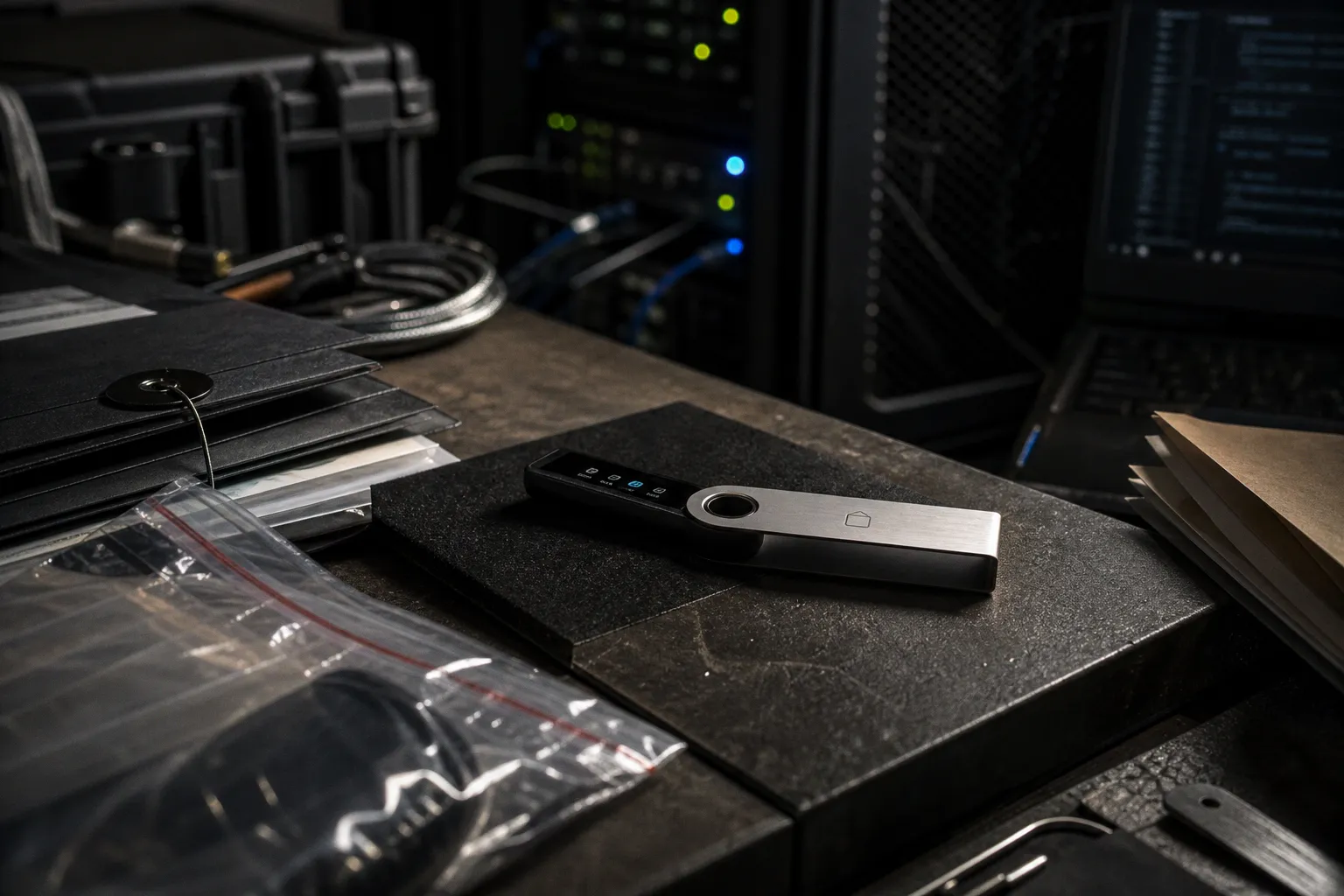
Private-key isolation, transaction parsing, recovery design, firmware transparency, and physical access controls all determine whether an NFT holder has reduced risk or merely moved it into a different layer.
For NFT portfolios, this distinction is material. A wallet may hold high-value collection assets with thin market depth, fragmented bids, and no reliable exit at the displayed floor price. Losing control of one signing key can therefore create a loss that is not recoverable through ordinary market execution. There is no chargeback mechanism. There is no order-book reversal.
Hardware wallet cold storage reduces exposure to browser-wallet compromise, malicious extensions, and remote credential theft. It does not eliminate phishing, supply-chain manipulation, unsafe recovery handling, or blind signing.
Cold storage protects the private key. It does not automatically protect the decision to sign.
The best cold storage for NFTs is not necessarily the device with the longest feature list. It is the device whose security model matches the owner's transaction frequency, custody structure, recovery discipline, and tolerance for operational friction.
Secure Element chips: what EAL ratings actually indicate
A Secure Element, often shortened to SE, is a dedicated hardware component intended to store and process sensitive cryptographic material under physical attack resistance. In hardware wallets, the relevant material is the private key or the secret used to derive it.
The distinction matters because a general-purpose microcontroller and a Secure Element do not face the same threat model. A Secure Element is designed to resist extraction attempts involving fault injection, power analysis, probing, and other side-channel techniques. It is not a guarantee that a wallet cannot be compromised. It is a control against a specific class of physical attacks.
Security certifications are commonly described through Evaluation Assurance Levels, or EAL ratings. In this category, EAL5+ and EAL6+ are common reference points for Secure Elements. Higher ratings indicate more rigorous evaluation requirements for the chip's security properties. Some devices market EAL7-grade protection, a level associated with unusually high assurance requirements.
The practical interpretation should remain narrow:
| Parameter | What it addresses | What it does not address |
|---|---|---|
| Secure Element chip | Physical extraction of key material, side-channel attacks, tampering attempts | Malicious transaction approval, phishing, unsafe seed backup |
| EAL5+ or EAL6+ certification | Assurance level of the chip evaluation process | Overall security of the wallet application or user behavior |
| Device PIN | Unauthorized local use after theft or loss | Recovery phrase theft |
| On-device display | Verification of recipient, contract, and amount | User failure to read or interpret the display |
A high-rated Secure Element is most relevant where device theft, seizure, or hands-on tampering is part of the risk model. This includes collectors who travel with a wallet, operators holding treasury assets, or NFT traders who store hardware in shared workspaces.
It is less decisive against the more common retail failure: approving a malicious marketplace interaction through a browser wallet. If the user signs an opaque contract approval, the Secure Element has done its job. The user authorized the transaction.
When choosing a hardware wallet, examine how the manufacturer describes its key architecture:
- Is the private key generated inside the device?
- Does the private key remain inside the Secure Element during signing?
- Is the device designed to expose a public address but never export the signing secret?
- Can the device independently show the destination address, token approval, and transaction parameters?
- Does the vendor document which component holds the key material and which component renders transaction data?
The last question is often skipped. It should not be. Security depends not only on where the key sits, but also on whether the display path can be trusted when a transaction is reviewed.
Air-gapped signing reduces one attack surface, not every attack surface
Air-gapped hardware wallets avoid direct network and wireless connections. They do not use USB data transfer, Bluetooth, or NFC for signing communication. Instead, they commonly exchange unsigned and signed transaction data through QR codes or microSD cards.
The security benefit is straightforward: the signing device remains physically separated from an internet-connected computer or phone. Malware on a browser machine cannot establish a direct data channel to the wallet through a cable or wireless pairing protocol.
That changes the remote attack surface. It does not remove it.
An air-gapped device still receives transaction data. A QR code is data. A microSD file is data. If the wallet firmware incorrectly parses that data, fails to sanitize inputs, or displays incomplete transaction details, the offline boundary has not prevented a logical-layer failure.
This is the operational comparison:
| Connection model | Main advantage | Primary trade-off | Suitable use case |
|---|---|---|---|
| USB-connected wallet | Efficient desktop workflow; broad software support | Direct connection to an online host during transaction flow | Frequent trading with disciplined address verification |
| Bluetooth or NFC wallet | Mobile convenience; reduced cable handling | Wireless protocol and pairing add another security layer | Mobile-first users with small operational balances |
| Air-gapped QR wallet | No network, USB, Bluetooth, or NFC connection to signer | Slower workflow; QR parsing and display quality become critical | Long-term NFT custody and low-frequency transfers |
| Air-gapped microSD wallet | Isolated file-based transaction transfer | Removable-media handling and file integrity risks | Segregated custody environments |
Bluetooth-enabled hardware wallets should not be treated as inherently unsafe. Proper encryption and on-device confirmation are designed to mitigate interception and man-in-the-middle risk. The relevant question is whether the additional convenience is worth the expanded protocol surface for a particular holder.
For a collector moving NFTs once per quarter, QR-based signing may be a rational trade. For an active trader managing bids, listings, and token swaps across several marketplaces, repeated air-gapped execution can produce operational errors of its own: missed confirmations, address confusion, or rushed review under market pressure.
NFT custody has a separate complication. Many NFT interactions do not resemble a simple token transfer. Marketplace listings, collection offers, bulk transfers, and approval revocations may involve contract calls that are harder to inspect than a destination address and ETH amount. Hardware wallet cold storage is strongest when the device and its companion software provide legible transaction decoding.
A device that displays only a hash or an unreadable contract payload is not giving the holder meaningful verification. It is moving blind signing onto a smaller screen.
This is particularly relevant during periods of concentrated token movement and changing liquidity conditions. Large on-chain movements, vesting unlocks, and whale wallet activity should be read as signals worth investigating, not as instructions to follow. The same discipline applies to wallet security: a transaction prompt is evidence to inspect, not a routine click to approve.
An offline signer is valuable only if its screen gives the holder enough information to reject a bad transaction.
Recovery design: BIP-39 is simple, Shamir Backup changes the failure model
Most hardware wallets use a BIP-39 recovery phrase, usually 12, 18, or 24 words. Those words represent the backup required to regenerate the wallet's private keys. Anyone holding the phrase can control the assets. No PIN, device, or biometric control changes that fact.
This creates a concentrated-risk problem. The recovery phrase is both essential and dangerous:
- Lose it, and the wallet may become unrecoverable after device loss or failure.
- Expose it, and the attacker can restore the wallet on another device.
- Store it digitally, and the "cold" component of the custody plan may no longer be meaningful.
- Split it incorrectly, and the owner can create a recovery process too complex to execute under stress.
Shamir Backup, commonly implemented under the SLIP-39 standard, changes this structure. Instead of one complete recovery phrase, the backup can be divided into multiple recovery shares. Restoration requires a predetermined threshold, such as 2-of-3 or 3-of-5 shares. Some implementations support up to 16 shares.
The model removes the single point of failure. It also creates a system that must be administered correctly.
| Backup method | Failure point | Recovery complexity | Appropriate profile |
|---|---|---|---|
| Single BIP-39 seed | One stolen or destroyed phrase compromises recovery | Low | Individual holder with secure, controlled physical storage |
| BIP-39 seed plus passphrase | Seed alone may not restore the main wallet | Medium to high | Advanced user able to document and preserve passphrase procedures |
| Shamir Backup / SLIP-39 | Threshold of shares must be available | Medium | Long-term holder seeking geographic or organizational redundancy |
| Multisignature custody | Required signing quorum must be available | High | Teams, treasuries, and portfolios with formal controls |
Shamir Backup is not universally supported. A buyer should verify compatibility before assuming that a device can import or generate SLIP-39 shares. This is not a small implementation detail. A recovery format that cannot be restored by the available hardware and software is not a backup.
The placement of shares also needs a threat model. Three shares stored in the same apartment are not meaningful geographic redundancy. A 2-of-3 structure with one share in a safe deposit facility, one in a controlled home safe, and one with a trusted legal or custody arrangement may reduce single-location loss. It also increases coordination risk.
For high-value NFT collections, a passphrase can add another separation layer. It can create a distinct wallet derived from the same seed phrase, sometimes called a hidden wallet. This can be useful, but it creates a strict condition: the passphrase is part of the recovery process. If it is forgotten, the assets may be inaccessible despite possession of the seed.
Do not photograph a seed phrase. Do not type it into a note-taking app. Do not enter it into a website claiming to "verify," "sync," or "repair" a wallet. A legitimate hardware wallet recovery flow occurs on the trusted device, not in a browser pop-up.
PIN controls and physical access are the last local barrier
A stolen device should not provide immediate access to the wallet. PIN protection is the first barrier against local use, while the recovery phrase remains the ultimate control plane.
Trezor devices, for example, increase the waiting period after each incorrect PIN attempt and automatically wipe the device after 16 failed attempts. Some devices support PIN lengths of up to 50 digits. Those features materially increase the cost of repeated guessing.
The PIN still has limits. It protects the device, not the assets in an absolute sense. If an attacker also possesses the recovery seed, wiping the device is irrelevant. If the wallet remains unlocked on a desk, PIN strength is irrelevant. If the user approves a fraudulent transaction while holding the device, PIN protection has already been bypassed by authorization.
A workable physical security routine has four components:
1. Use a nontrivial PIN. Avoid dates, repeated digits, and patterns tied to public information. The PIN should not be stored with the wallet.
2. Keep the device and recovery backup separate. A hardware wallet stored beside its seed phrase is not a custody system. It is a single package containing both the lock and the key.
3. Verify tamper indicators and purchase channels. Hardware wallets should come from the manufacturer or an authorized channel. A device arriving with a prewritten seed phrase, altered packaging, or instructions to import a supplied recovery phrase should be treated as compromised.
4. Maintain a small transaction wallet. For frequent marketplace approvals, use a separate hot wallet with limited funds and no core collection inventory. The cold wallet should not be the default browser-connected account for every mint, claim, and free-token interaction.
This separation is especially useful in NFT markets because approvals can outlive a single transaction. A wallet that approves an operator contract may grant asset-transfer permissions that remain active until revoked or limited by the contract's design. Cold storage should therefore be paired with approval hygiene, not substituted for it.
Open-source firmware versus closed-source Secure Element design
Firmware is the software that governs the hardware wallet's behavior: seed generation, transaction parsing, display logic, PIN handling, and signature creation. The device may have a strong Secure Element, but its practical security still depends on what the firmware asks the chip to sign.
Open-source firmware allows independent researchers to inspect code, identify flaws, reproduce builds, and assess whether the implementation aligns with the manufacturer's claims. Trezor is commonly associated with an open-source approach.
Closed-source firmware, used in parts of the architecture of some other wallet brands, limits public inspection of the relevant code. That does not automatically mean the device is unsafe. Vendors may argue that closed components protect proprietary security design or are constrained by Secure Element vendor agreements. The trade-off is reduced external visibility.
This is not a simple "open equals safe, closed equals unsafe" comparison. The more useful assessment is whether the manufacturer provides enough evidence of security engineering:
- Clear documentation of the device architecture.
- Independent security reviews or a credible vulnerability-disclosure process.
- Signed firmware updates and transparent update procedures.
- A history of responding to reported issues.
- Explicit transaction-display behavior for common chains and NFT contract calls.
- Clear statements on whether firmware can be reproduced or independently audited.
- A defined policy for device replacement, support, and security updates.
Firmware update policy deserves particular attention. A wallet that never updates can retain known weaknesses. A wallet that updates without clear user confirmation can create a separate trust problem. The holder should understand whether updates are optional, how authenticity is verified, and what happens if a device is not updated for an extended period.
For NFT users, compatibility can pressure security decisions. A wallet may support Ethereum transfers well but show limited context for newer chains, marketplace standards, or complex batch transactions. Broad chain support is useful only when the transaction confirmation layer remains intelligible.
Selecting a hardware wallet by custody profile
Hardware wallet comparisons often become product-feature lists. That is inefficient. Start with the custody profile, then identify the control set required.
A low-frequency collector holding several high-value NFTs has different requirements than a daily trader running market-making orders across multiple collections. The right device for the first profile may be a poor fit for the second.
Long-term NFT custody
The collector who transfers assets once or twice per year should prioritize recovery design, key isolation, and display clarity over speed. Air-gapped signing is acceptable because transaction frequency is low. A Secure Element with documented EAL rating, a Shamir Backup option, and legible transaction decoding for marketplace contracts are the relevant signals. Convenience features such as Bluetooth or mobile pairing carry less weight because they are rarely used.
Active NFT trading
A trader executing listings, offers, and portfolio rebalancing benefits from a wallet that integrates cleanly with the marketplace workflow. Cold storage for this profile means a device used to sign high-value movements, with a separate hot wallet handling smaller, more frequent transactions. PIN discipline, approval hygiene, and fast on-device confirmation become more important than the strongest possible EAL rating, because physical seizure is less likely than transaction-flow mistakes.
Treasury and team custody
Group custody introduces multisignature requirements that go beyond a single hardware wallet. In that setting, the wallet is one signing device among several. Recovery shares, signer distribution, and procedural controls matter more than the brand on the box. The wallet's role is to enforce that no single device compromise can move treasury assets.
Travel and shared environments
Collectors who carry a device across borders or store it in a shared workspace should weight tamper resistance, PIN strength, and wipe-on-failure behavior more heavily. Air-gapped operation also reduces exposure to compromised hotel or venue networks, which is a practical benefit beyond the headline security claim.
Documented recovery drill
Regardless of profile, the recovery process should be tested. A wallet restored from backup on a second device, in a controlled setting, confirms that the seed, passphrase, or Shamir shares are usable. A backup that has never been restored is not a confirmed backup; it is an untested assumption.
Where cold storage stops and discipline begins
Hardware wallet cold storage is a foundation, not a finished system. The device handles key isolation and transaction signing. It does not decide which marketplace contract deserves approval, whether an airdrop claim is worth the permission grant, or how the recovery phrase is stored between sessions.
NFT holders who treat the wallet as the entire security strategy tend to concentrate risk in the parts the device cannot see. The holder who treats it as one layer in a wider custody discipline tends to keep losses small when something does go wrong, because the next layer was already in place.
The features worth paying for are the ones that make the next failure less catastrophic: a Secure Element that resists tampering, a recovery scheme that does not collapse from a single mistake, a screen that actually shows what is being signed, and a firmware process that does not require blind trust. Everything else is accessory.