Hardware wallet security: essential features for safe selection
A hardware wallet can keep a private key away from browser malware, but it cannot reverse a signature already authorized by its owner. That distinction determines most NFT losses. The device protects key custody.
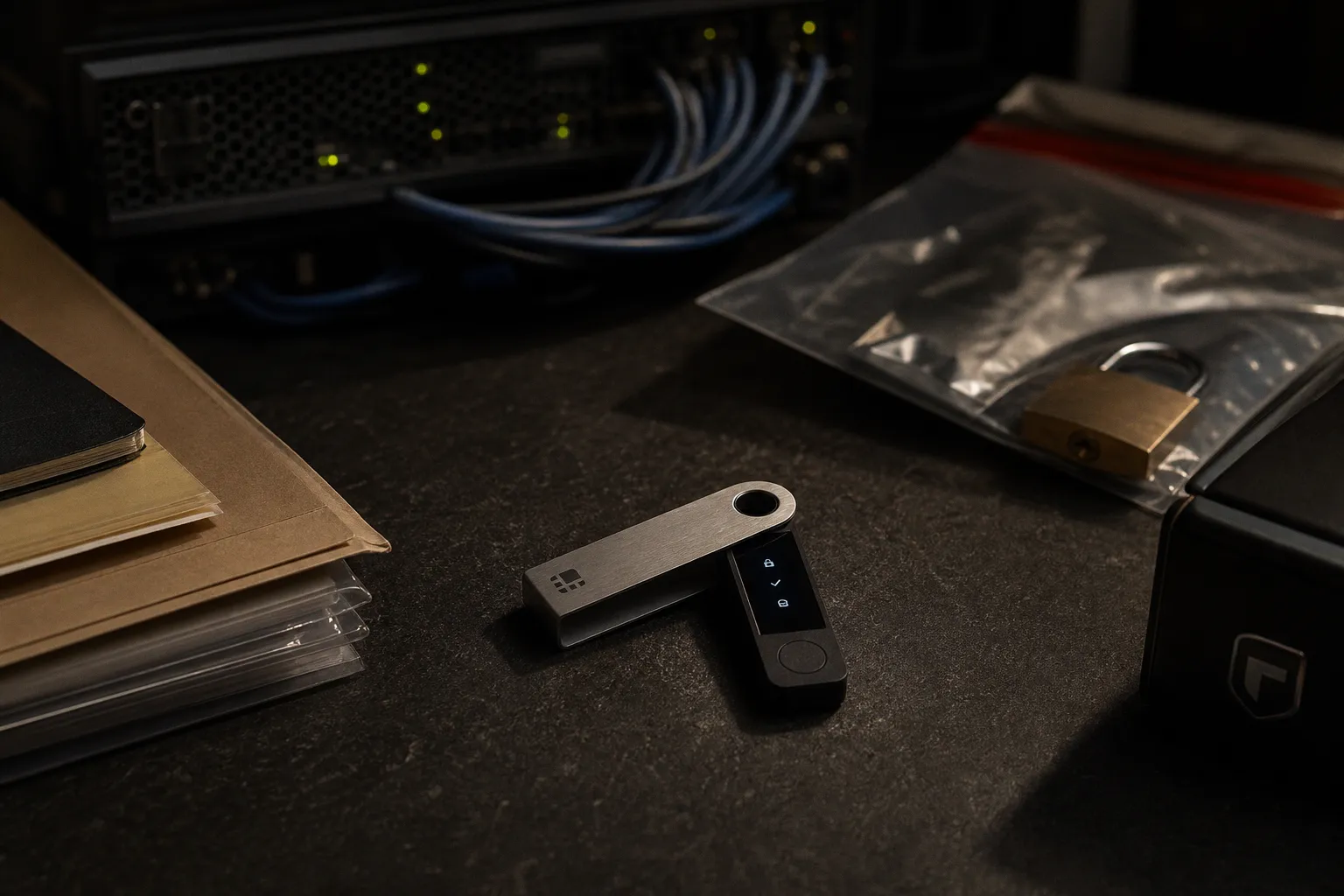
It does not assess marketplace intent, validate a listing price, or distinguish a legitimate Seaport-style approval from a malicious authorization presented through a phishing dapp.
The data architecture is straightforward: keys remain inside the wallet, transactions are signed there, and the connected phone or computer only broadcasts the signed result. That is a material reduction in exposure. It is not a complete security model. For NFT collectors, hardware wallet security depends on six layers: key isolation, screen verification, firmware integrity, supply-chain control, recovery design, and signature discipline.
The architecture of offline key management
A hardware wallet does not store NFTs or cryptocurrency. Assets remain on-chain. The wallet protects the private keys that control those assets.
The operational advantage is that a compromised browser extension, laptop, or mobile device should not be able to extract the private key from the hardware wallet. The host can construct a transaction. It can send that transaction to the wallet. But the signing operation happens inside the device.
That separation matters most in routine NFT activity:
- Connecting to a marketplace does not expose the private key to the marketplace.
- A browser malware infection has a harder path to direct key theft.
- A malicious extension cannot silently sign a transfer if the hardware wallet requires physical confirmation.
- The wallet display becomes the final transaction-verification surface.
The last point is the critical one. A device that signs offline but provides weak transaction visibility leaves the user dependent on an infected host’s interpretation of the transaction. Strong hardware wallet security requires a display that is controlled by the wallet itself and can show meaningful transaction details before approval.
For a standard native-token transfer, this means reviewing the recipient address and amount on-device. For NFT activity, the analysis is more difficult. Marketplace transactions can involve contract addresses, collection contracts, token IDs, operators, approvals, and typed-data messages. The wallet may not always render every element in human-readable form.
That limitation creates a practical hierarchy:
| Control | What it reduces | What it does not reduce |
|---|---|---|
| Private key isolation | Key theft from compromised browser or desktop malware | Fraudulent approvals authorized by the owner |
| On-device confirmation | Silent transaction substitution by a compromised host | Errors caused by unreadable or poorly understood transaction data |
| Offline or air-gapped transaction signing | Direct device-to-host attack surface in some workflows | Malicious transaction payloads prepared before signing |
| PIN protection | Casual access to the physical device | Recovery-phrase compromise |
| BIP39 passphrase | Exposure of a primary wallet if the recovery phrase is found | Loss caused by forgetting the passphrase |
| Multisignature custody | Single-key failure and single-device compromise | Poor signer operations or weak recovery planning |
“Air-gapped transaction signing” requires similar scrutiny. QR-code or removable-media workflows can reduce direct connectivity between device and host. They do not make a transaction safe by default. A hostile website can still generate a hostile transaction. The user can still approve it. Connectivity architecture reduces one class of attack surface; transaction verification remains separate.
A hardware wallet protects keys from the host. It does not protect the owner from approving the host’s request.
Secure Elements and EAL certification: useful, not conclusive
A Secure Element is a dedicated chip designed to protect sensitive information and resist certain physical attacks. In hardware wallets, it commonly holds or helps protect secret material used for signing.
This is a valid selection criterion. It is not a complete answer.
Some devices advertise a Secure Element with an EAL6+ certification level. That figure refers to an evaluation framework for a particular component under a defined scope. It can indicate that the chip has undergone substantial assessment against relevant attack methods. It does not certify the entire wallet system.
The distinction is routinely lost in product comparisons. An EAL rating does not automatically validate:
- the wallet firmware;
- the bootloader and update mechanism;
- the desktop or mobile companion application;
- the browser-wallet connection;
- the transaction-parsing logic;
- the display rendering;
- the supply chain;
- the owner’s backup process.
A Secure Element may be EAL6+ while the user still signs an unlimited token approval on a spoofed site. Both facts can be true at the same time.
The relevant question is therefore not “Does this wallet have a Secure Element?” It is: “How does the device use it within the full signing architecture?”
A rigorous evaluation should examine four points.
1. Secret handling. The manufacturer should explain whether private-key material is generated and retained within protected hardware, and how export is prevented during normal use.
2. Display trust. The wallet must present confirmation data on a screen controlled by the device, not merely mirror data supplied by the computer. A compromised computer can alter browser content. It should not be able to alter the final confirmation displayed by the wallet.
3. PIN-failure behavior. Brute-force resistance varies by model. Some devices add increasing delays after incorrect PIN entries. Others can wipe a protected secret after a defined number of failed attempts. The exact behavior should be understood before funds are loaded.
4. System transparency. Hardware design, firmware source availability, third-party audit history, vulnerability disclosures, and update practices matter alongside chip certification. Open source security audits do not guarantee safety, but they create a more inspectable security process than opaque claims alone.
Collectors should avoid treating a Secure Element as a marketing shorthand for invulnerability. Hardware wallet physical tampering, firmware compromise, coerced access, fake recovery prompts, and unsafe approvals sit outside the narrow promise of a certified chip.
Firmware integrity and supply-chain verification
The wallet lifecycle starts before the first transaction. A counterfeit or previously accessed device can defeat security before the owner creates a PIN.
The lowest-risk acquisition path is direct purchase from the manufacturer, its verified storefront, or an authorized reseller explicitly named by the manufacturer. Used devices, informal marketplace listings, and “sealed” units from unknown sellers create an unnecessary supply-chain variable. A factory-looking box is not an authenticity check.
The setup sequence should be controlled and repeatable:
1. Inspect the source before the package. Confirm that the seller is listed by the manufacturer. Do not rely on marketplace reviews, packaging photos, or a discount that appears temporary.
2. Initialize the wallet personally. The recovery phrase must be generated during the owner’s own initialization process. A prewritten seed card is a compromise indicator, not a convenience.
3. Reject any supplied recovery phrase. No legitimate device requires the owner to use a phrase printed by a seller, sent through email, or included in a support message.
4. Install the official companion software from the manufacturer’s verified channel. Search-engine ads, cloned download pages, and fake browser extensions remain common distribution routes for wallet malware.
5. Run the device’s firmware authenticity checks. Some wallet software compares installed firmware details against known legitimate values and verifies firmware hashes. A mismatch is a stop signal. Funds should not be transferred in anticipation that the issue will resolve itself.
6. Apply firmware updates deliberately. Updates can address vulnerabilities, improve compatibility, and modify transaction-display behavior. The update process should occur from a clean, trusted environment—not through a link delivered by email, Discord, or a direct message.
Firmware verification is not an optional technical detail. The wallet’s trust model depends on the integrity of code that generates keys, unlocks secrets, parses transactions, and drives the confirmation display.
A collector evaluating closed-source and open-source designs should not reduce the decision to ideology. Source visibility can improve reviewability. It does not eliminate implementation bugs, supply-chain risks, or unsafe user behavior. Conversely, a closed component may have hardened physical protections but less public inspectability. The useful comparison is concrete: update process, disclosure record, verification tooling, architecture, and transaction transparency.
The device is only as trustworthy as its initialization path and firmware-verification process.
Beyond the PIN: recovery phrases, passphrases, and BIP39 entropy
A PIN protects the physical device. A recovery phrase protects control of the wallet. These are different assets with different failure modes.
If an attacker obtains the recovery phrase, the attacker does not need the hardware wallet or its PIN. They can restore the wallet elsewhere. If the owner loses the hardware wallet but retains the recovery phrase, control can generally be recovered on a compatible wallet. This makes seed phrase protection the core custody problem.
BIP39 supports mnemonic phrases of 12, 15, 18, 21, or 24 words. At the common endpoints:
- A 12-word mnemonic represents 128 bits of entropy plus a 4-bit checksum.
- A 24-word mnemonic represents 256 bits of entropy plus an 8-bit checksum.
- The mnemonic and optional passphrase are processed using PBKDF2-HMAC-SHA512 with 2,048 iterations to derive a 512-bit seed.
The arithmetic matters less than the operational rule: the phrase must never be photographed, typed into a phone or computer, placed in cloud storage, entered into a website, or sent to support staff. A digital copy converts a physical backup problem into a potentially indefinite remote-exfiltration problem.
Seed phrase encryption is often discussed as if it removes this exposure. It does not remove it. It changes the backup design. Encrypted storage introduces a second dependency: the encryption password and the ability to access and correctly decrypt the file years later. For most individual collectors, an offline, durable, accurately recorded physical backup held in a secure location is simpler than a custom encryption system that only one person understands.
A BIP39 passphrase can create an additional wallet derived from the same mnemonic. This is useful, but unforgiving. Every passphrase produces a valid deterministic wallet. There is no error message stating that the passphrase was almost correct. A missing character, changed capitalization, or forgotten punctuation derives a different wallet.
The operational implications are severe:
- The passphrase is not a replacement for the recovery phrase.
- The passphrase must be backed up with equal care, but not necessarily in the same location as the mnemonic.
- A “decoy wallet” arrangement can add complexity under pressure and can fail if the structure is not documented for legitimate recovery.
- Before using a passphrase for meaningful value, the owner should test restoration with a small balance and a written recovery procedure.
A PIN can be memorized. A recovery phrase must be recoverable. A passphrase must be both secret and recoverable. Confusing those requirements is a common self-custody failure.
The limit of device protection: signature phishing
NFT phishing has changed from obvious private-key theft to authorization abuse. The current threat is frequently a wallet prompt that looks routine: sign in, verify ownership, claim an airdrop, update a listing, or receive a reward.
The hardware wallet may display a confirmation request. The user may approve it. The loss can still occur.
Two patterns require immediate caution.
Airdropped NFT bait
Unexpected NFTs can contain names, descriptions, or metadata directing the recipient to an external website. The objective is usually one of two things:
- obtain the recovery phrase or private key through a fake validation page;
- induce a transaction or signature that grants an attacker authority over assets.
An unsolicited NFT has no operational value until proven otherwise. It should not be opened through a linked site, listed through an unfamiliar interface, or used as a reason to “synchronize” a wallet. Hiding or ignoring it is usually the correct response.
Off-chain signature phishing
Off-chain signatures can be more deceptive because they may not trigger an immediate on-chain transfer or gas payment. A fraudulent dapp can ask the owner to sign a message that later supports a listing, order, permit, or withdrawal mechanism. The asset may remain visible in the wallet after the signature. That delay is precisely what makes the attack effective.
Before approving any signature, the collector should establish all of the following:
- the exact domain is the intended marketplace domain, not a visually similar copy;
- the connection originated from a trusted bookmark or manually verified address, not an ad, direct message, or airdrop instruction;
- the wallet is signing an action expected at that moment;
- the request does not grant a broad operator approval or create an unexpected listing;
- the displayed contract and network match the collection and marketplace being used.
Browser wallet extensions remain a weak point because they bridge the NFT marketplace interface and the signing device. A hardware wallet reduces the impact of an extension compromise on key extraction. It does not make a malicious extension’s prompt economically harmless.
The practical response is account separation. Use a low-value hot wallet for experimental mints, unfamiliar dapps, and broad marketplace interaction. Use the hardware wallet as the vault account. Move acquired assets into cold custody after the interaction is complete. This creates transaction friction. That friction is a control, not a defect.
Scaling security for high-value collections with multisignature
A single hardware wallet is still a single point of operational failure. The device can be lost. The recovery phrase can be exposed. The owner can approve the wrong transaction. For collections with material value, multisignature custody can reduce dependence on one key.
A multisignature account requires multiple authorized signers to approve an operation before execution. A 2-of-3 configuration, for example, can require any two of three independent signers. One signer alone cannot transfer assets.
The security improvement comes from separation:
- Each signer can use a distinct hardware wallet.
- Devices can be acquired through separate purchase channels and initialized independently.
- Recovery materials can be stored in separate secure locations.
- A malicious approval on one signer does not automatically execute the transfer.
- Loss of one signer does not necessarily cause permanent loss if the threshold remains reachable.
This architecture introduces operational cost. NFT marketplaces and smart contracts do not always support multisignature workflows with the same simplicity as a single externally owned account. Signing may require multiple devices, coordination, and explicit transaction review. Recovery becomes a governance process rather than an individual action.
The threshold should match the real risk model. A 2-of-3 structure can absorb one compromised or unavailable signer. A 3-of-5 structure adds resilience but increases administrative overhead. There is no universal best configuration.
For a sole collector, multisignature may be excessive for a small portfolio and rational for a concentrated, high-value collection. The decision should be based on custody concentration, frequency of trading, recovery needs, and the ability to maintain disciplined signer separation over time.
Selection standard: assess the system, not the feature list
Hardware wallet security is not a binary product attribute. It is a chain of controls. The chain fails at its weakest operational point: a compromised seed backup, unverified firmware update, counterfeit device, careless signature, or single-key custody model that exceeds the owner’s risk tolerance.
A defensible selection process prioritizes:
- on-device confirmation with useful transaction visibility;
- a documented and verifiable firmware-authenticity process;
- direct or authorized purchase channels;
- a clear explanation of Secure Element architecture without exaggerated certification claims;
- recovery procedures that never require entering the mnemonic into an internet-connected device;
- a tested passphrase strategy only where its complexity is justified;
- separate wallets for active marketplace activity and long-term NFT custody;
- multisignature thresholds when a single signer represents unacceptable concentration risk.
The decisive metric is not how many security labels appear on the packaging. It is whether the wallet’s architecture, setup process, backup design, and signing workflow still hold when the browser is compromised, the marketplace prompt is fraudulent, and the owner is under time pressure.